
Setting and Achieving OKRs

(Photo from Muryeong Road, Ulsan 🇰🇷 울산 무롱로)
OKRs have been a part of many companies that I've worked at since they're an effective way to align folks in an organization from top to bottom, empirically and transparently.
Setting OKRs
objective
- Goal/what we want to change or achieve
- Directional
key result
- what metric do we want to influence
- Measurable, reasonably achievable
- Choose 2-4, each with a target number (and optional stretch target)
- Too many == harder to focus
initiative
- how we do it
- Things we do (like projects) to achieve the key results
- Assign a DRI/Driver for the initiative
- DRI = Directly Responsible Individual (from Apple)
Derive program OKRs from company mission/vision/goals/objective. How does your program or team fit into the org? Work with stakeholders.
Hierarchy: everything should flow into their parent:
company mission/vision/goals ← program objectives/KRs ← program initiatives ← individual work items
Tracking/linking
Try to connect every piece of work the team member does with an OKR (even maintenance work if possible).
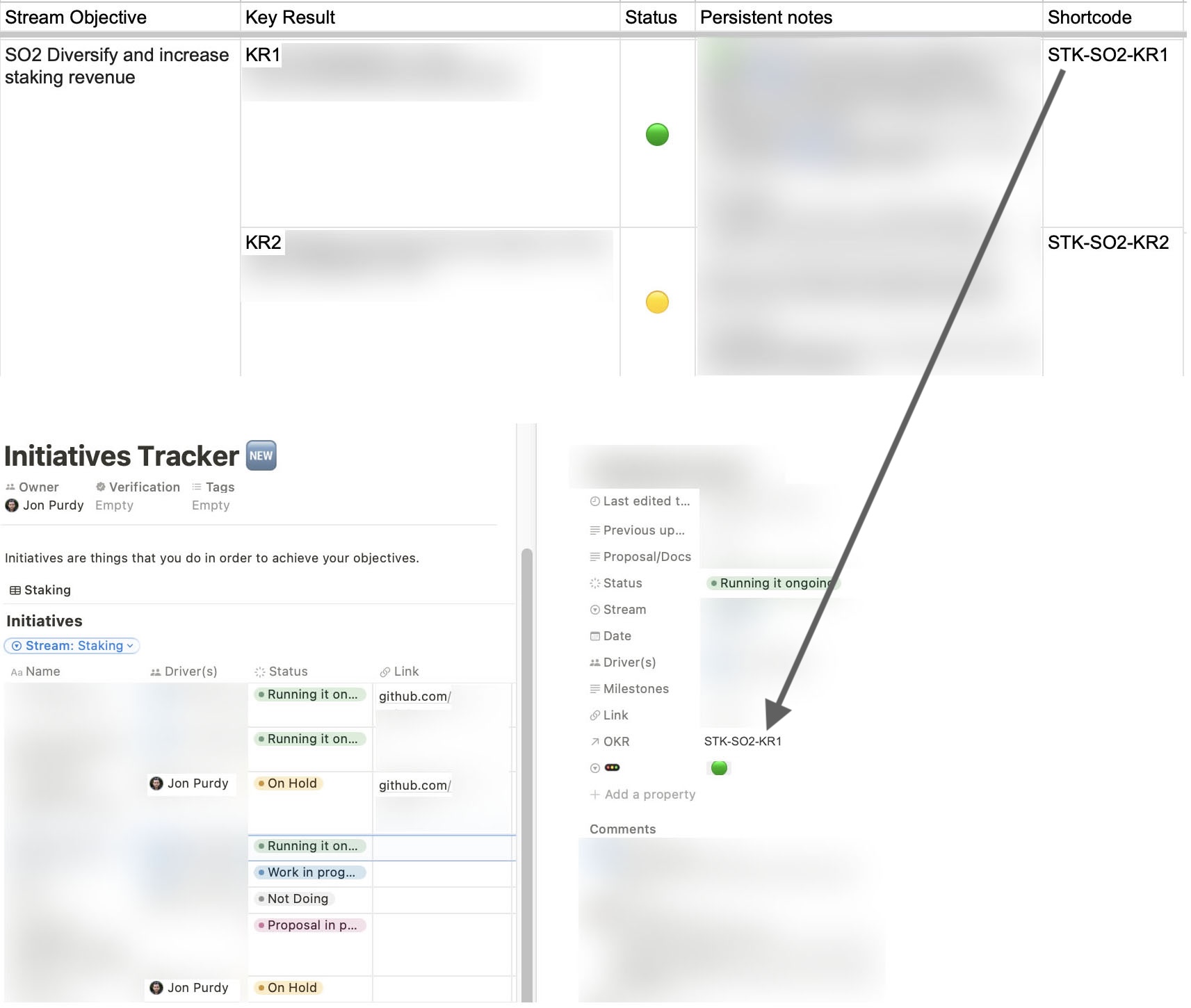
- Each OKR gets a shortcode (O1-KR2), which can be set up in any tool used by the team (Notion, Github, Sheets, etc)
- Enables everyone on the team to use them and reference them for everything they do
- Ideally, track OKRs in one place, but if you don't like the prescribed tool you can track them in your own preferred tool as well
Cadence
Annual vs quarterly
- Objectives: annual or quarterly depending on scale (or roll them over each quarter)
- I prefer quarterly for KRs for faster iteration and adaptation
- Review KRs periodically (bi-weekly?)
- See How I Work Cyclically for more info on this
Examples
Imagine you ran an infrastructure program for a blockchain company (like me). Lets say the company had typical goals: earn money, and avoiding security breaches.
Assumptions: - These OKRs are quarterly - Baselines are mostly calculated from the previous quarter's numbers
Security-related
Objective 1: Reduce centralized point of failures to ensure reliability
| KRs |
|---|
| ① Move 5% of Validators and BNs to non-Lodestar |
| ② Geth is less than 10% of EL nodes (45/45/10 Nethermind/Besu/Geth) |
Objective 2: Improve incident prevention and response
| KRs |
|---|
| ① Reduced TTD (time to detect) by 20% |
| ② Reduced TTR (time to resolve) by 10% |
| ③ Reduced avoidable incident count by 20% |
Objective 3: Increase security of production infra
| KRs |
|---|
| ① Measure and reduce number of attack vectors by 20% |
| ② Measure and reduce time to offboard |
Notes:
- ✅ Objectives are what we want to change/directional
- ✅ KRs are quantitative/measurable, influencing specific metrics
- Objectives all work towards the company goals of earning money and avoiding security breaches
- For all KRs, need to determine baseline then ensure % change is achievable
- O1-KR2: this is based on publicly-known risks of a Geth supermajority circa 2023-2024
- O2-KR3: avoidable: subjective, but incidents that could have been reasonably avoided with better systems, processes, or monitoring. Example: server crashes due to out of disk space; avoidable by setting alerts and reasonable thresholds.
- O3-KR2: offboard means revoke credentials for an individual (in case of compromise). Setting a baseline for this would be a bit subjective but important to run through an offboarding session to get this.
Revenue-related
Objective 4: Increase and diversify revenue
| KRs |
|---|
| ① At least 3 revenue streams contribute ≥10% of total revenue” |
| ② Revenue has increased by 10% (denominated in ETH) |
Notes:
- ✅ Objective is what we want to change/directional
- ✅ KRs are quantitative/measurable, influencing specific metrics'
- ① I based this on an actual KR "Participated in 3 new revenue-generating opportunities". Improved by changing ambiguous "participated" to actually contributing revenue and defined a % of total revenue.
- ② Need to ensure % change is achievable
- ② Also, need to separate independent variables. If revenue is denominated in USD, but price of cryptocurrency increases, revenue would increase but not be caused by the initiatives/actions of the program.